

If you’re planning next year’s pipeline, you’ve probably felt the squeeze: audiences tune out ads, stakeholders want measurable returns, and teams need moments that create content, conversation, and conversion. That’s exactly why Marketing Ideas San Francisco are shifting from “fun events” to experience-led growth bets.
The highest-ROI Marketing Ideas San Francisco in 2026 combine a memorable in-person moment with trackable digital follow-through. The winning formula behind the best Marketing Ideas San Francisco is simple: design a shareable experience, capture first-party data ethically, and tie outcomes to pipeline and retention.
This guide gives you 10 experiential plays (grounded in what’s working for experiential marketing San Francisco teams) that work particularly well for corporate and working professionals in the Bay Area, plus an ROI measurement model you can reuse for every activation.
A practical definition: what counts as experiential marketing in 2026?
Experiential marketing is the practice of creating a real-world (or hybrid) brand experience that people actively participate in, not just passively watch. In 2026, the important shift is instrumentation: the experience is designed to generate measurable outcomes, not only “buzz.”
Global spending on experiential marketing has been forecast to surpass pre-pandemic levels, reflecting how brands are reallocating budgets toward experiences.
The ROI model you should use before picking any idea
Before you pick your first tactic, pick your measurement design. In our work with corporate teams, the simplest model that holds up in budget reviews is:
- North-star outcome: pipeline influenced, renewals, qualified meetings, or candidate applications (choose one primary).
- Leading indicators: sign-ups, demo requests, content saves, QR scans, on-site meetings booked.
- Experience KPIs: dwell time, participation rate, NPS-style “would you recommend,” UGC volume.
- Attribution plan: unique QR/UTM per experience zone, calendar-booking links, badge scans, post-event nurture.
- Cost model: fully loaded cost per qualified meeting, per sales-accepted lead, or per retained account.
This makes “event marketing ROI” defensible, and it keeps Marketing Ideas San Francisco focused on outcomes because you can connect the moment to a downstream behavior, not just a photo.
Budget, timeline, and resourcing so these Marketing Ideas San Francisco don’t die in procurement
Most teams pick a concept first and discover constraints later. Flip that: start with your ceiling, then choose the Marketing Ideas San Francisco format that fits.
Budget tiers you can defend:
- Lean pilot ($5k–$20k): workshop, micro-summit, or a single interactive demo station. Great when you need to prove Marketing Ideas San Francisco can influence the pipeline quickly.
- Mid-scale ($20k–$75k): a branded lounge, a multi-station demo build, or a one-day pop-up partnership. This is where many Marketing Ideas San Francisco deliver the best cost-per-meeting.
- Flagship ($75k+): multi-day pop-ups, large-scale art installations, or integrated conference “plus-one” experiences. Flagships can work, but only when your measurement design is mature and your follow-up motion is staffed.
Timeline reality check for Marketing Ideas San Francisco:
- 2-3 weeks: venue, concept, landing page, tracking, partner alignment
- 4-6 weeks: production, content plan, speaker/host coordination, legal and permits
- 6-10 weeks: larger builds, multi-partner activations, or anything with street frontage
If your timeline is tight, choose Marketing Ideas San Francisco that are modular: a workshop series, a micro-summit, or a pop-up inside an existing venue rather than building from scratch.
A simple KPI dashboard you can screenshot into your weekly update
When leaders ask “Did it work?”, answer with a one-page view:
- Reach: RSVPs, attendance rate, content views (live + post-event)
- Engagement: dwell time, participation rate, sessions completed
- Demand: meetings booked, demos requested, sales-accepted leads
- Revenue link: pipeline influenced, closed-won influenced (even if lagging)
- Efficiency: cost per qualified meeting, cost per SAL, cost per influenced dollar
The 10 proven Marketing Ideas San Francisco for 2026
1) The “micro-summit” inside a real venue, not a hotel ballroom
Targets: experiential marketing San Francisco, corporate event marketing strategy, event marketing ROI
Instead of a full conference, host a 60–120 minute micro-summit: three short talks, one panel, and structured networking. The unlock is choosing a venue that already signals credibility (museum, gallery, waterfront space) and designing the program around one decision-maker problem.
Make it ROI-friendly:
- Gate attendance with one high-intent question: “What are you trying to improve in the next 90 days?”
- Offer “10-minute clinics” that book calendar slots on the spot.
- Use a follow-up asset: a concise recap deck plus two relevant case studies.
2) “Try-it-now” interactive product demo stations
Targets: interactive product demo event, how to measure experiential marketing ROI
Experiential works when the product is felt, not explained, which is why this is one of the most reliable Marketing Ideas San Francisco for B2B teams. Build demo stations that let people complete a real job-to-be-done in under five minutes. Think: “solve X in 3 clicks,” “compare before/after,” “build your own dashboard,” or “taste the difference.”
Measurement tip: give each station its own QR/UTM so you can see which demo converts best.
3) Pop-up partnership with the local “revival” ecosystem
Targets: San Francisco pop-up activation, local partnerships in San Francisco, brand activation San Francisco
San Francisco has a strong pop-up culture, including programs aimed at activating vacant storefronts and driving foot traffic downtown. That ecosystem creates built-in curiosity and press-adjacent momentum. citeturn3news36
Your role: sponsor a pop-up with a clear experience hook (workshop, sampling, interactive art, product trial) and co-market with the host brand.
Why it’s a strong Marketing Ideas San Francisco play: you borrow trust from a local operator and gain content and community signals in a single move.
4) “Neighborhood proof” activations: Mission, SoMa, and beyond
Targets: community-based marketing in San Francisco, street team marketing San Francisco
This is the B2B version of street-level relevance. Create a small activation that fits a neighborhood’s vibe: coffee + product education in SoMa, design-focused installations near Hayes Valley, or food-forward pairings in the Mission.
A good benchmark is Square’s community hub approach: they used a well-known Mission District storefront as a pop-up space for local business support and events. citeturn3news35
Operational note: keep permits and crowd management simple by designing for “small, steady flow,” not mass turnout.
5) Conference “plus-one” experiences that outperform sponsorship booths
Targets: conference sponsorship ideas San Francisco, brand activation San Francisco
If you sponsor a conference, the booth is table stakes. The smartest Marketing Ideas San Francisco treat the booth as a check-in point, not the main event. The ROI comes from the “plus-one” experience: a quiet lounge for booked meetings, a content studio for 10-minute recordings, or an invite-only dinner that your sales team can actually follow up from.
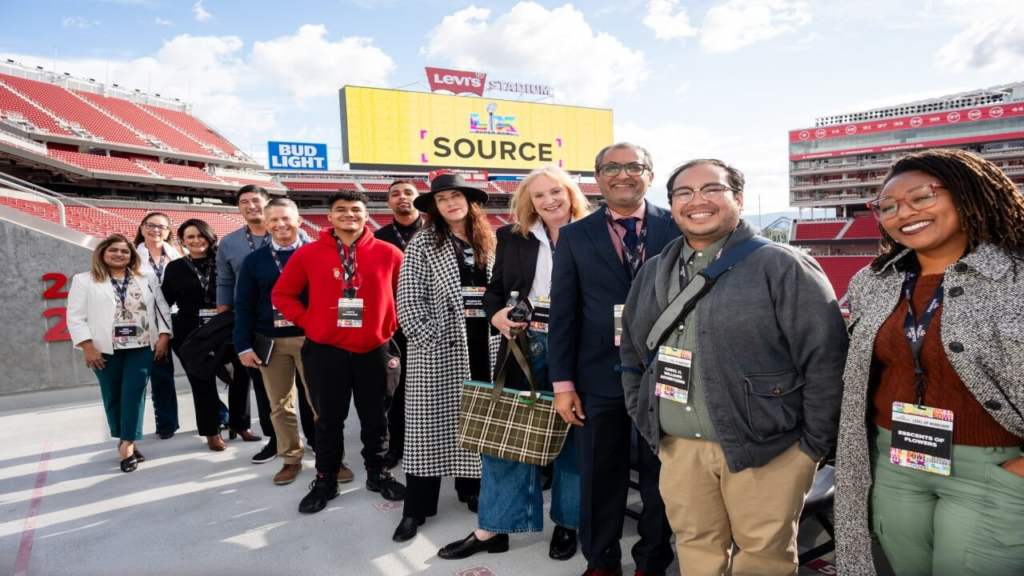
If you need planning context, the Bay Area continues to be a dense cluster for marketing and GTM events.
6) Hybrid activations designed for content capture
Targets: hybrid event activation, AI personalization at events
Hybrid is not “stream the event.” For many brand activation San Francisco programs, hybrid is the easiest way to scale beyond the room. It’s “create two connected experiences”: an on-site moment for locals and a digital moment for everyone else. The best hybrid activations are built around:
- One signature on-site ritual (photo moment, interactive build, challenge)
- One digital extension (live Q&A, downloadable toolkit, post-event office hours)
Add lightweight personalization on-site (badge scan preferences, “choose your track” QR) and use it to tailor the follow-up sequence.
7) Experiential retail, even if you are not a retailer
Targets: experiential retail ideas, experiential marketing San Francisco
Even B2B brands can borrow the retail playbook: create a “walk-through” environment that tells your story in 5 scenes, then end with a clear next step. Experiential retail is about making the experience itself the reason to show up. citeturn0search16
ROI angle: treat each “scene” like a funnel step and track drop-off.
8) Civic-calendar tie-ins done tastefully
Targets: experiential marketing ideas 2026, local partnerships in San Francisco
San Francisco’s public events calendar creates natural spikes in attention. A good example is the kind of brand planning that clusters around major cultural moments and big gatherings. citeturn0search1
The rule is simple: align only if you can add value to the audience, not just borrow attention. For example, a “recharge lounge” for professionals, a skills workshop series, or a volunteer-driven community activity that matches your brand.
9) “Skills-forward” workshops for working professionals
Targets: corporate event marketing strategy, event marketing ROI
Workshops convert because they deliver value immediately. The twist for 2026 is to build them around a measurable skill outcome:
- “Build a 30-day plan”
- “Audit your funnel in 45 minutes”
- “Turn one case study into five assets”
Square’s local-business content highlights how practical, operator-first guidance can resonate when it’s rooted in real examples. citeturn3search10
Make it scalable: record the workshop, turn it into a gated asset, and run the same session quarterly.
10) The “experience-to-advocacy” loop
Targets: employee advocacy for local marketing, event marketing ROI
This is the underrated corporate lever: turn your own employees and customers into the distribution engine. The activation is simple:
- Invite customers + employees to co-host a small gathering
- Capture short “why we chose this” stories (video or written)
- Publish as a local proof series, then retarget and nurture
Done right, you get trust, content, and referrals without buying attention twice.
How to choose the right idea for your team
Pick your Marketing Ideas San Francisco based on constraints, not ambition. Great Marketing Ideas San Francisco are designed around the realities of calendar time, sales capacity, and budget governance.
- If your sales cycle is long, prioritize micro-summits, dinners, and workshop formats.
- If your product is visual, prioritize demo stations and walk-through experiences.
- If you need brand lift plus leads, prioritize pop-ups and hybrid content capture.
Key Takeaways
- The best Marketing Ideas San Francisco in 2026 pair a memorable moment with trackable digital follow-through.
- A micro-summit plus on-site clinic slots is one of the fastest ways to generate qualified meetings.
- Pop-up partnerships let you borrow local trust while creating high-quality content and community signals.
- Hybrid activations work when the digital layer is designed, not bolted on.
- “Experience-to-advocacy” loops can lower acquisition costs by turning customers and employees into distribution.
Conclusion
Experiential is no longer the “brand team’s fun project.” In 2026, it is a measurable growth channel when you design the experience around a clear outcome, instrument it with simple tracking, and build the follow-up path before you build the stage.
If you want a practical next step, choose one idea from this list, run it as a pilot, and hold yourself to the same standard you would for any other growth experiment: hypothesis, measurement, iteration. That is how Marketing Ideas San Francisco became a repeatable ROI engine.
FAQs
What are the best Marketing Ideas San Francisco for B2B companies?
Micro-summits, skills workshops, and “plus-one” conference experiences work best as Marketing Ideas San Francisco because they create qualified conversations and measurable follow-through, not just impressions.
How do you measure event marketing ROI without overcomplicating attribution?
Use unique QR/UTM links by zone, track meeting bookings as the primary conversion, and align post-event nurture to the same tags. Then report cost per qualified meeting and pipeline influenced.
Are pop-ups in San Francisco still effective in 2026?
Yes, especially when they are tied to an existing local ecosystem (retail revitalization, community programming, partner brands). The key is to co-market and design a clear participation hook. citeturn3news36
What budget range do corporate experiential activations usually require?
It varies widely. A small workshop can run in the low thousands, while a multi-day pop-up can reach six figures. Start from your ROI model: decide an acceptable cost per qualified meeting, then design backward.
What experiential marketing trends matter most for 2026 planning?
Expect more hybrid experiences built for content, more first-party data capture, and more emphasis on credibility signals: partners, communities, and measurable outcomes. Broader market research continues to highlight strong consumer preference for experiences and event-driven engagement.